Public speaking for students: a method you can practise
Confident speakers are made, not born. A method students can practise: one message, a simple structure, rehearsal aloud, and handling nerves and questions.
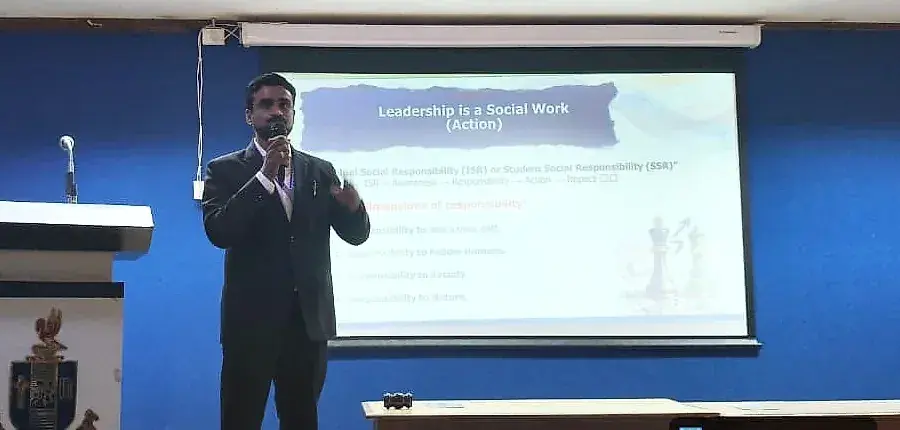
I train students in soft skills and speak at colleges, and in September 2026 I was guest of honour at Bishop Heber College’s one-day programme on effective public speaking. The question students ask me most is some version of “How do I stop being scared?” My honest answer is that confident speakers are not born that way. They follow a method, and they practise it. Here is the method.
1. Decide the one message
Before you write a slide or a sentence, finish this line: If my audience remembers only one thing, it should be… That is your message. Every point, story and number in the talk either supports it or comes out.
Most weak presentations fail here. They try to say everything the speaker knows, and the audience leaves remembering nothing.
2. Use a structure the audience can follow
Listeners cannot scroll back. Give them a shape:
- Opening (about 10%). A question, a surprising fact or a short real example, then your message in one sentence. Never open with “Good morning, today I am going to talk about…” and a long thank-you list; keep courtesies brief.
- Body (about 80%). Three points, each supporting the message. Three is easy to remember. Signpost them: “First… Second… Finally…”
- Close (about 10%). Repeat the message in fresh words and, if it fits, say what you want the audience to do.
For short answers in interviews, group discussions and vivas, use PREP: Point, Reason, Example, Point. “I’d choose a franchise model (point), because it lets the company grow without heavy capital (reason). That is how many Indian food brands have expanded (example). So for this firm, franchising is the better route (point).”
3. Rehearse out loud, standing up
Reading your notes silently is not rehearsal. Your mouth needs to practise the words. Stand up, speak at full volume, and time yourself.
- First run: you will find the parts that do not flow.
- Second run: fix them.
- Third run: time it, and cut if you are over.
Memorise the opening, the links between points and the closing line. Do not memorise the rest word for word; know your points in order and speak them naturally.
4. Use your voice and body on purpose
- Pace: most nervous speakers rush. Slow down to a little below conversation speed.
- Pauses: pause after an important line. Silence that feels long to you feels natural to the audience.
- Eye contact: look at one person for a full sentence, then another, across the room.
- Stance: stand still with your weight on both feet. Let your hands move naturally; avoid gripping the lectern.
- Volume: speak to the last row. If there is a microphone, keep it at a steady distance.
5. Make slides help, not compete
Slides are for the audience, not your script. One idea per slide, a few words, large type, and a picture or chart where it explains better than text. If you are reading your slides aloud, the audience does not need you.
6. Handle nerves
Nervousness is your body preparing to perform. It does not go away entirely, even for experienced speakers, but you can manage it:
- Breathe slowly before you begin, with the out-breath longer than the in-breath.
- Know your first two sentences by heart. The first minute is the hardest; once it is past, most nerves settle.
- Find friendly faces and speak to them first.
- If you lose your place, pause, look at your notes, and continue. The audience rarely notices.
7. Handle questions
Listen to the whole question. Repeat or rephrase it so everyone hears it. Answer briefly, using PREP. If you do not know, say so and offer to find out; that earns more respect than bluffing.
8. Speaking in a second language
Many of my students think in Tamil and present in English. That is a strength, not a handicap. Audiences need clarity, not a particular accent. Speak slightly slower, finish your word endings, choose simple words over impressive ones, and pause between ideas. If a word will not come, describe it. Fluency grows with practice, not before it.
A practice plan for one month
- Week 1: record a one-minute talk on your phone about anything you know well. Watch it once and note one thing to improve.
- Week 2: answer three interview-style questions aloud using PREP.
- Week 3: give a three-minute talk to two friends, and ask them what they remembered.
- Week 4: volunteer to speak in class, at a club or at an event.
Confidence comes after the practice, not before it. Start small, and start this week.
Common questions
How can a student overcome stage fear?
Prepare thoroughly, rehearse out loud several times, and know your first two sentences by heart. Before speaking, breathe slowly, with a longer out-breath than in-breath. On stage, speak your first sentence slowly and find two or three friendly faces to talk to. Nervousness usually falls after the first minute, and it falls further with every talk you give.
What is the PREP method of speaking?
PREP is a structure for short answers and impromptu speeches: state your Point, give the Reason, support it with an Example, and finish by restating the Point. It works in interviews, group discussions and viva questions.
How long should a student presentation be rehearsed?
Rehearse out loud, at full length, at least three times: once to find the problems, once to fix them, and once to time it. If the talk is important, rehearse once in front of a friend who can tell you what they remembered.
Should I memorise my speech?
Memorise the opening, the transitions between points and the closing line. Do not memorise the rest word for word: if you forget one word, you can lose the thread. Know your points in order and speak them in natural sentences.
Is it a problem to speak English with a regional accent?
No. Audiences need clarity, not a particular accent. Speak a little slower than in conversation, finish your word endings, pause between ideas, and choose simple words over impressive ones.